Video Recording
10.06.2026 PMAC Ag Meeting and Roundtable
Location: LHPUSD Boardroom and Zoom 6pm
Boad Attendance: Dr. Patrick Horn, Nicholas Erridge, Cullen Rose, Dr. Kassandra Talbot (Zoom)
Absent: Ryan Augustine
Quorum Achieved: Yes
Virtual Attendance: 1
In-Person Attendance: 26
Interpretation Services (Spanish/English): Present
Quick recap
The PMAC (Planning and Management Advisory Committee) held a special meeting focused on agriculture, with Corin Whittle, the Agricultural Commissioner and Sealer of Weights and Measures, presenting the annual crop report for San Mateo County. The presentation showed that agricultural production in 2025 reached $116,361,000, representing a 9.3% increase from 2024 and ranking the county 40th out of 58 counties in California's $60 billion agricultural industry. Floral and nursery crops were identified as the largest commodity group at $52 million, with indoor-grown plants comprising 45% of the total production value. Following the presentation, council members and agricultural representatives discussed challenges facing local agriculture, including market access issues, rising costs, labor shortages, and the decline of traditional crops like Brussels sprouts and artichokes. BJ emphasized the need for developing a distribution center in Half Moon Bay to help farmers reach the 8 million people in the Bay Area market, noting that agricultural land use had significantly declined from previous generations.
Investigate the feasibility of a program to aggregate and sell ecosystem services (e.g., carbon sequestration, biodiversity) as an additional income stream for farmers.
Consider creating a database or archive of all crops historically grown in the county, leveraging the knowledge of experienced farmers.
San Mateo County Crop Report
The meeting focused on the annual crop report presentation by Koren Widdle (Director, Ag Commissioner/Sealer). Widdle explained the purpose of the crop report, which is mandated by the Food and Agricultural Code to provide production values for the county, helping producers make agricultural decisions, suppliers support the industry, legislators inform policy-making, and planners target services. The presentation also highlighted the differences between the annual crop report and the USDA Census of Agriculture, noting that while the USDA Census is required every five years, the annual crop report relies on voluntary participation from the industry.
2025 Agricultural Crop Report Presentation
Widdle presented the 2025 agricultural crop report showing a production value of $116,361,000, representing a 9.3% increase from 2024 and ranking the county 40th out of 58 in California's $60 billion agricultural industry. The report highlighted floral and nursery crops as the largest commodity group at $52 million, with indoor-grown plants comprising 45% of the total production value. Widdle explained that crops with fewer than three producers are categorized as miscellaneous, and noted that while cannabis production has been declining, it is not included in official production reports due to federal recognition issues.
Agricultural Production and Challenges
Widdle presented agricultural production data showing a 9.3% increase in overall production value, though noted this represents gross production and doesn't account for input costs or farmer margins. The discussion revealed challenges facing coastal agriculture, including land availability, water access, labor shortages, increasing regulatory requirements, and rising input costs, with Brussels sprouts production declining 21% due to growers moving operations south to areas like Watsonville and Salinas. Widdle explained that while the county doesn't currently track agricultural production geographically or by labor statistics, an economic model estimates 1,900 agricultural-related jobs in the county, and the full economic report is available on the county website.
Agricultural Challenges and Solutions
BJ from the Farm Bureau reported significant challenges in local agriculture, highlighting the decline in agricultural production due to distant markets, high shipping costs, and rising land and housing prices that make it difficult for farm workers to afford living in the area. BJ emphasized the need for a distribution center in Half Moon Bay to help farmers reach the 8 million people in the Bay Area and prevent further decline in agricultural production. Francisco Hernandez, farm manager for Zucigim Farm, discussed the farm's challenges with funding, labor, and housing, noting that they are currently operating with only two staff members due to financial constraints and staffing issues.
Pescadero Farming Challenges Discussion
Attendees discussed the challenges facing farming in Pescadero, including increased regulatory costs for water usage, aging workforce, housing issues driving young farmers away, and declining crop prices. Cole, a farmer at Brisa Ranch and operator of Coastside Local Food Hub, explained how consolidation in the distribution market and competition from large growers like Taylor have made it difficult for smaller operations to thrive, despite their efforts to create markets for newer growers through forward contracts. Everyone agreed that while returning to historical production levels seems unlikely, focusing on creating viable new operations and maintaining strong institutional markets could help strengthen the local farming community.
San Mateo County Farm Challenges
Attendees discussed challenges facing San Mateo County farmers, including regulatory burdens, land tenure issues, and housing problems affecting both farmers and farm workers. A suggestion was made that the county could focus on ensuring institutional buyers like hospitals and schools source produce from local growers, and proposed making Williamson Act benefits contingent on good lease terms for farmers. Brandon Stewart from MidPen presented their agricultural policy focusing on preserving operations, sustainable agriculture, and diversity, highlighting their work with over 15,000 acres of grazing land and successful brush reduction projects covering 801 acres over two years.
Agricultural Collaboration and Pond Project
Attendees discussed the importance of finding the right collaborator to engage with the local agricultural community and outlined strengths such as available funding and strong board support. A debate ensued regarding a pond project at Johnson Ranch, with MidPen defending the decision to build a new pond rather than clean the existing one, citing environmental and agricultural benefits. The RCD representative explained their services, including providing compost, recycling programs, and assistance with funding opportunities for farmers. Larry Jacobs, a local farmer, encouraged continued support for agriculture and emphasized the importance of preserving prime land for future farming needs.
Pescadero Agriculture Community Discussion
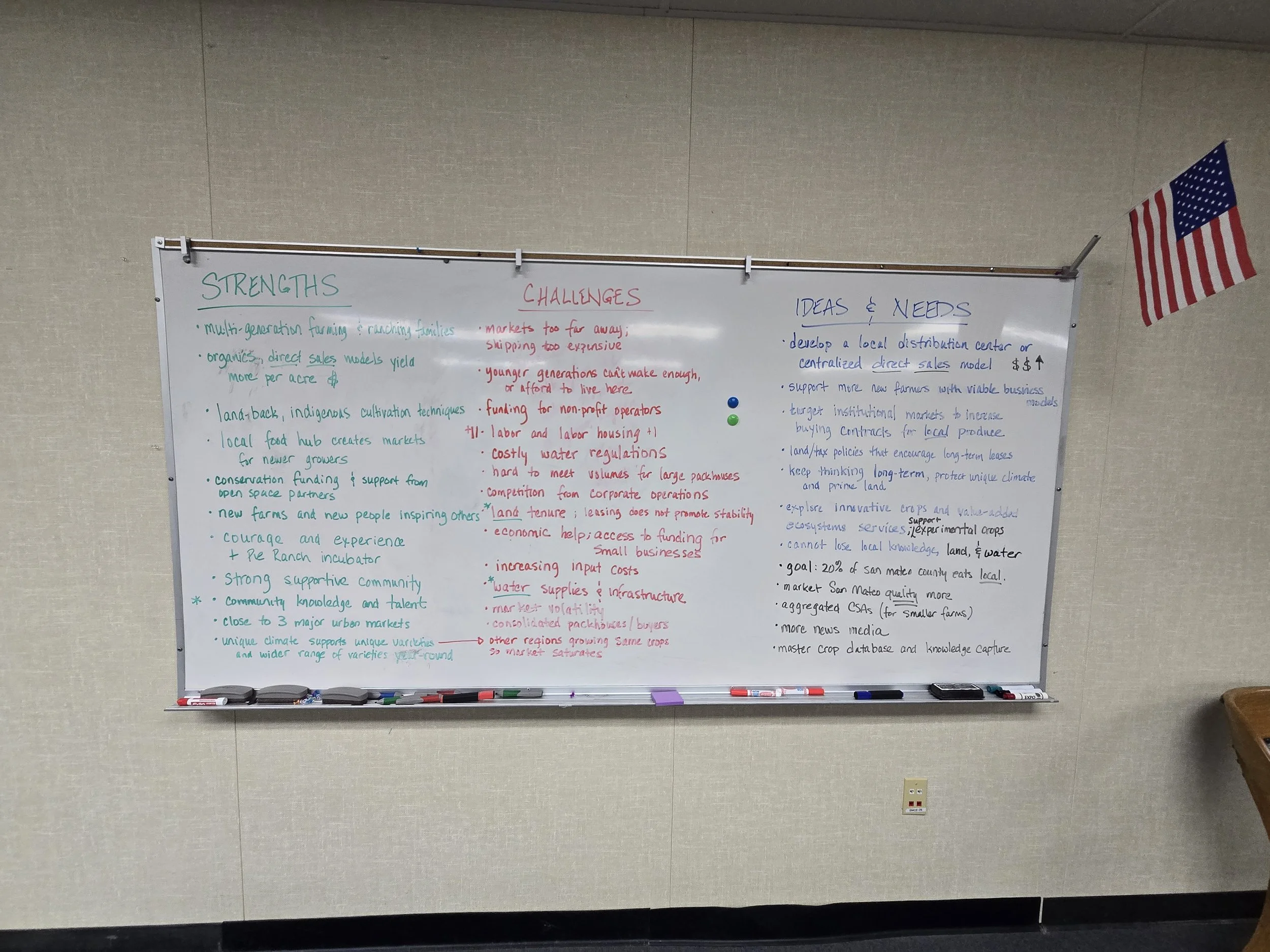
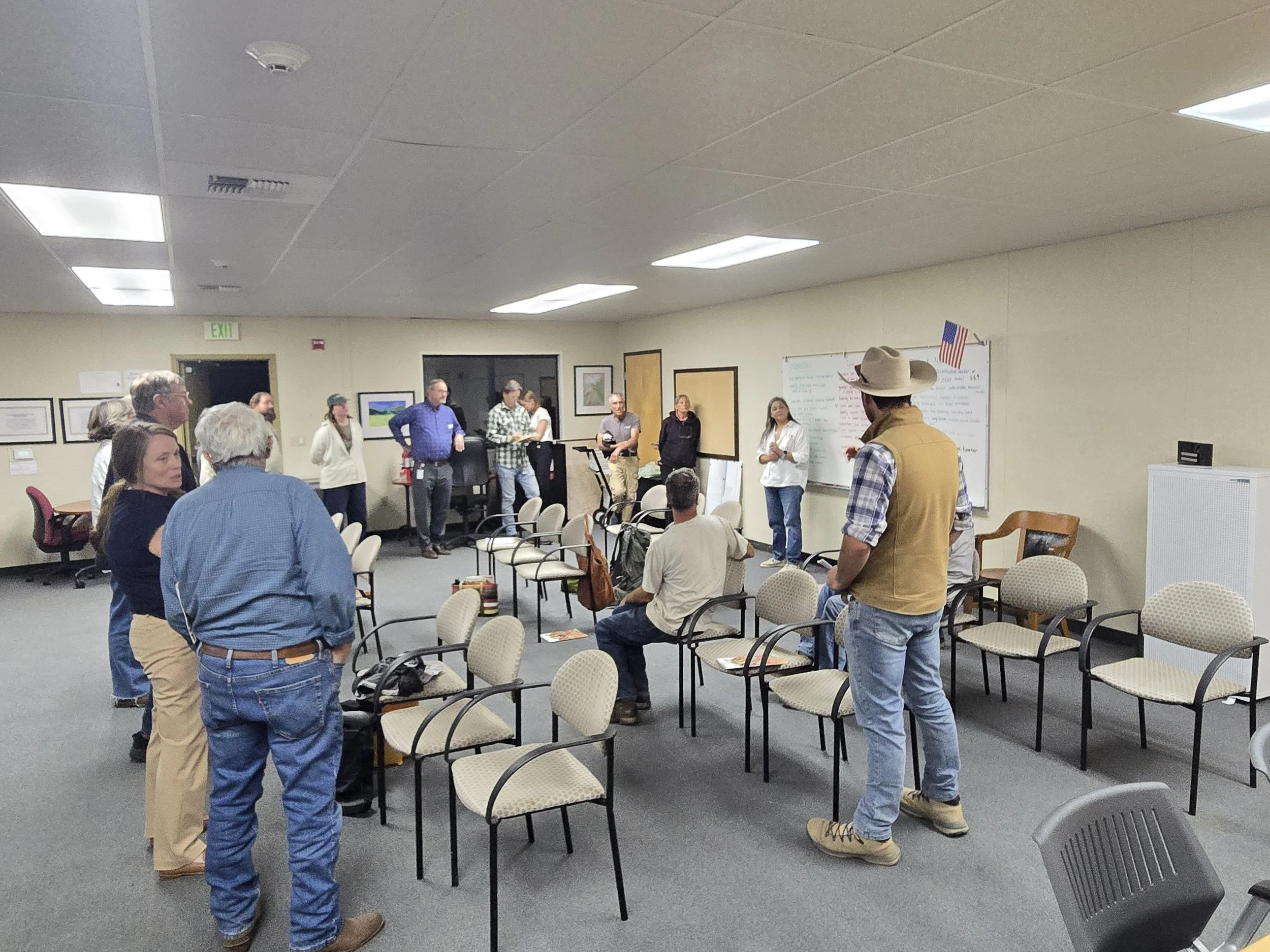
The meeting featured several participants sharing their experiences and perspectives on agriculture in the Pescadero area. Margarito Gomez discussed how local farms have evolved over 25 years, while Maria Savala described her journey from working at Singletary flower farm to starting her own business with support from the Pie Ranch program. Nicholas Romero Gonzalez shared his extensive agricultural background and emphasized the importance of continued collaboration during challenging economic times. Karen Curtiss from Red Dot Ranch outlined her farm's focus on education and nutrient-dense food, while also discussing potential ecosystem services and carbon sequestration opportunities. The conversation ended with plans to review inputs captured on a board under categories of strengths, challenges, ideas, and needs.
Regional Agricultural Strengths and Challenges
The group discussed agricultural strengths and challenges in their region. They identified multi-generation farming families, organic direct sales models, and local knowledge as key strengths, while highlighting concerns about market volatility, limited distribution options, and the loss of agricultural knowledge to younger generations. The discussion touched on specific challenges with Brussels sprouts production and pricing, as well as the impact of distributor consolidation on local farmers. They also explored potential opportunities in institutional markets like schools, hospitals, and tech companies, though noted that some of these markets have become less accessible in recent years.
Agricultural Distribution Center Planning
Attendees emphasized the need for POST to step up and invest in creating a distribution center to support agriculture in San Mateo County, highlighting the potential benefits for both agriculture and landowners. The discussion explored San Mateo County's agricultural advantages, particularly its ability to grow a wide range of crops year-round, and the challenges faced by smaller farmers. Participants discussed potential marketing strategies, including promoting local produce quality and utilizing social media, while also considering the creation of a comprehensive database of crops grown in the area to help guide new farmers.
Collaboration
RCD: Assists growers with applications for NRCS EQIP, CSP, and other farm bill programs, with a deadline of November 6.
RCD: Provides compost at free or low cost to growers.
RCD: Offers the drip tape recycling program again this winter.
Next steps
Brandon Stewart (MidPen)
Recruit and hire a suitable candidate to fill the vacant agricultural support position at MidPen.
Francisco Hernandez
Connect with grant writers and sources to secure more funding for Zucigim Farm.
PMAC
Share the link to the economic report on the PMAC website for easy access (https://www.smcgov.org/agwm/agricultural-crop-report)
Ensure that the minutes from this meeting include the summarized strengths, challenges, ideas, and needs discussed.
Follow up with invited agencies (Farm Worker Advisory Commission, Ag Advisory Council, POST) who did not attend to gather their priorities and perspectives.
Explore the idea of a centralized agricultural distribution center in Half Moon Bay, potentially in partnership with POST and the Farm Bureau.